

[2025] Use Valid PK0-005 Exam - Actual Exam Question & Answer
Test Engine to Practice PK0-005 Test Questions
NEW QUESTION # 169
A project sponsor asked the PM to provide a summary of the current financial status. The PM uses the following burn up chart for the analysis: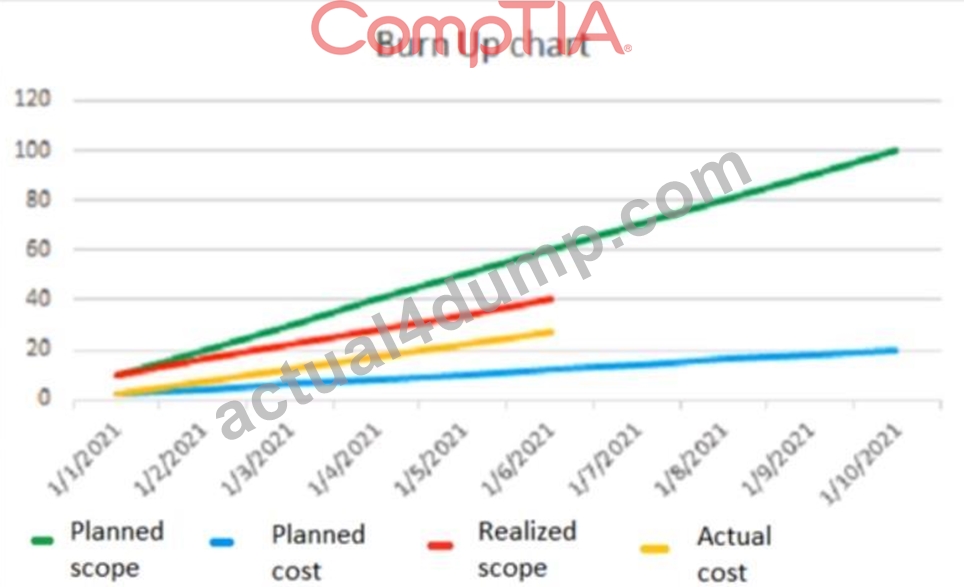
Based on the chart, which of the following is the current status of the project?
- A. Ahead of schedule and under budget
- B. Behind schedule and over budget
- C. Behind schedule and under budget
- D. Ahead of schedule and over budget
Answer: B
Explanation:
The project manager can use the burn up chart to analyze the current status of the project based on its scope (value delivered), budget (cost), and schedule (time). A burn up chart is a graphical tool that shows how much work has been completed (burned up) versus how much work remains (scope) over time. It also shows how much budget has been spent (burned up) versus how much budget remains (budget) over time. A burn up chart can help to monitor and control the project progress and performance and identify any variances or deviations from the plan. The chart given shows that both scope and budget lines are above their respective target lines at any given time point. This means that less work has been completed than planned (scope variance) and more money has been spent than planned (budget variance) at any given time point. Therefore, the project is behind schedule and over budget.
NEW QUESTION # 170
A PM is working on a strategy to store records. Which of the following dements must be included in this plan? (Select TWO)
- A. Risk management
- B. Communication management
- C. Issue management
- D. Data management
- E. Work breakdown structure
- F. Document management
Answer: D,F
Explanation:
A strategy to store records must include data management and document management as two essential elements. Data management is the process of ensuring that the data collected, stored, and used by the project is accurate, complete, consistent, secure, and accessible. Data management helps to maintain the quality and integrity of the project data and supports the analysis and reporting of the project outcomes1, p. 4 Document management is the process of creating, organizing, storing, retrieving, and disposing of project documents in a systematic and controlled way. Document management helps to ensure that the project documents are available, reliable, usable, and authentic throughout the project life cycle and beyond. Document management also helps to comply with the legal, regulatory, and organizational requirements for records retention and disposition2, p. 3
NEW QUESTION # 171
A client provides a project plan to the assigned project manager and suggests that the project manager and team just need to execute the plan. Upon further investigation, the document contains:
* Purpose
* Scope of work
* Location of work
* Period of performance
* Deliverables schedule
* Applicable standards
* Acceptance criteria
* Special requirements
* Payment schedule
Which of the following documents did the client provide to the project manager?
- A. RFP
- B. SOW
- C. SLA
- D. WBS
Answer: B
Explanation:
Explanation
The client provided a statement of work (SOW) to the project manager and suggested that the project manager and team just need to execute the plan. A SOW is a document that defines the scope, deliverables, schedule, and terms and conditions of a project or contract. A SOW typically includes information such as purpose, scope of work, location of work, period of performance, deliverables schedule, applicable standards, acceptance criteria, special requirements, and payment schedule. A SOW can help to establish a common understanding and agreement between the client and the service provider on what needs to be done and how it will be done.
NEW QUESTION # 172
A project sponsor asked the PM to provide a summary of the current financial status. The PM uses the following burn up chart for the analysis:
Based on the chart, which of the following is the current status of the project?
- A. Ahead of schedule and under budget
- B. Behind schedule and over budget
- C. Behind schedule and under budget
- D. Ahead of schedule and over budget
Answer: B
Explanation:
Explanation
The project manager can use the burn up chart to analyze the current status of the project based on its scope (value delivered), budget (cost), and schedule (time). A burn up chart is a graphical tool that shows how much work has been completed (burned up) versus how much work remains (scope) over time. It also shows how much budget has been spent (burned up) versus how much budget remains (budget) over time. A burn up chart can help to monitor and control the project progress and performance and identify any variances or deviations from the plan. The chart given shows that both scope and budget lines are above their respective target lines at any given time point. This means that less work has been completed than planned (scope variance) and more money has been spent than planned (budget variance) at any given time point. Therefore, the project is behind schedule and over budget.
NEW QUESTION # 173
Which of the following would be MOST beneficial to do before a call to ensure all meeting items are
addressed and the correct participants attend?
- A. Schedule a convenient time.
- B. Assign action items to attendees.
- C. Distribute an agenda.
- D. Email the minutes from the previous meeting.
Answer: C
Explanation:
The project manager should distribute an agenda before a call to ensure all meeting items are addressed and
the correct participants attend. An agenda is a document that outlines the purpose, topics, and objectives of a
meeting. It also includes information such as date, time, duration, location, attendees, and roles. Distributing
an agenda can help to prepare the participants for the meeting, set clear expectations, and facilitate a
productive and focused discussion12
NEW QUESTION # 174
A project manager realizes that a project will not be completed on time due to resource constraints. Which of the following actions should the project manager take NEXT?
- A. Trigger the contingency plan and communicate with the stakeholders.
- B. Work with the functional managers to create a work-around.
- C. Set up an escalation meeting with the sponsor.
- D. Submit a change request to the change control board.
- E. Transfer the risk by hiring a new vendor who was successful on a previous project.
Answer: D
Explanation:
Explanation
Submit a change request to the change control board. The project manager should submit a change request to the change control board (CCB) if they realize that the project will not be completed on time due to resource constraints. A change request is a formal proposal to modify any aspect of the project, such as scope, schedule, cost, quality, or resources. A change request must be submitted to the CCB, which is a group of stakeholders who are authorized to review and approve changes. Submitting a change request can help to document the impact of the resource constraints on the project and seek approval for any corrective actions or preventive actions12
NEW QUESTION # 175
A project manager is currently meeting with a vendor who completed the project work. All invoices associated with the project have been paid. Which of the following best describes the project manager's objective for the vendor meeting?
- A. Closing contracts
- B. Removing access
- C. Reassigning resources
- D. Evaluating the project
Answer: A
Explanation:
Closing contracts involves finalizing any remaining contractual obligations and formally closing out the relationship with the vendor. CompTIA Project+ emphasizes this as part of the project closure phase to ensure all legal and financial aspects are complete.
NEW QUESTION # 176
Due to multiple changes, the sign-off for the project scope baseline is delayed. The project sponsor has
restricted the budget for this project. Which of the following should the project manager MOST likely do to
move forward?
- A. Adjust the scope to stay within the cost.
- B. Initiate a formal change request to modify the cost
- C. Set a new cost using a lightweight estimation method.
- D. Communicate with the affected stakeholders.
Answer: D
Explanation:
The project manager should communicate with the affected stakeholders first after realizing that the sign-off
for the project scope baseline is delayed due to multiple changes and that the budget for this project is
restricted by the project sponsor. The affected stakeholders are those who have an interest or influence on the
project and may be impacted by any changes or delays. Communicating with them can help to explain the
situation, assess the impact, seek feedback, and manage expectations.
NEW QUESTION # 177
Which of the following activities would a project manager perform during the closing phase? (Select THREE).
- A. Lessons learned
- B. Statement of work sign-off
- C. Acquiring resources
- D. Removing resources
- E. Stakeholder analysis
- F. Removing access
- G. Risk analysis
Answer: A,D,F
Explanation:
Lessons learned, removing resources, and removing access are activities that a project manager would perform during the closing phase of a project. Lessons learned is a process of collecting and documenting the knowledge and experience gained from a project for future reference and improvement. Removing resources is a process of releasing or reallocating any human or material resources that were used for the project.
Removing access is a process of revoking any permissions or privileges that were granted to the project team members or stakeholders for accessing any systems or data related to the project. These activities can help to finalize and close a project successfully and ensure that all deliverables are transferred, all documentation is approved and archived, all contracts are closed, and all stakeholders are satisfied.
NEW QUESTION # 178
The goal of a project is to fulfill specific technical features requested by customers. Which of the following actions should the product owner take?
- A. Define the success criteria.
- B. Use a task board.
- C. Create a communication plan.
- D. Perform a root cause analysis.
Answer: A
Explanation:
In Agile methodologies, the Product Owner is responsible for defining and prioritizing the product requirements to ensure they align with customer needs. Defining success criteria involves establishing clear, measurable goals that determine whether the project's technical features meet customer expectations.
According to the CompTIA Project+ PK0-005 exam objectives, under Domain 1.1: Explain the basic characteristics of a project and various methodologies and frameworks used in IT projects, understanding roles and responsibilities, including that of the Product Owner, is essential.
NEW QUESTION # 179
Which of the following considers factors such as reliability, scalability, security, and cost-effectiveness within project goals and objectives?
- A. Data warehouse
- B. DevOps architecture
- C. Computing services
- D. Networking and connectivity
Answer: B
Explanation:
DevOps architecture integrates development and operations to enhance the software development lifecycle. It emphasizes continuous integration and delivery, automation, and collaboration, ensuring that factors like reliability, scalability, security, and cost-effectiveness are integral to project goals and objectives. By adopting DevOps practices, organizations can achieve faster deployment times, improved system stability, and efficient resource utilization.
According to the CompTIA Project+ PK0-005 exam objectives, under Domain 1.1: Explain the basic characteristics of a project and various methodologies and frameworks used in IT projects, DevOps is recognized as a methodology that supports these critical factors.
NEW QUESTION # 180
Several stakeholders have asked about how the requirements are being covered by the deliverables and the progress of each requirement Which of the following would be the best tool the project manager can use to provide this information to the stakeholders?
- A. Traceability matrix
- B. Project status report
- C. Risk register
- D. Change log
Answer: A
NEW QUESTION # 181
Which of the following activities would be performed during the project closure phase when the waterfall methodology is being used? (Select two).
- A. Validating the deliverables
- B. Updating the issue log
- C. Creating a backlog
- D. Reconciling the project budget
- E. Managing the quality of deliverables
- F. Performing a risk assessment
Answer: A,D
Explanation:
During the project closure phase in the waterfall methodology, it is crucial to validate the deliverables to ensure that all project requirements have been met and the project outputs are complete and satisfactory.
Additionally, reconciling the project budget is performed to ensure all financial records are accurate and reflect the actual project costs, which is essential for the formal closing of the project.
References = CompTIA Project+ Certification Study Guide (PK0-005)
NEW QUESTION # 182
A project manager was just assigned to a new project. Which of the following activities should the project manager undertake after accepting the project? (Select TWO).
- A. Develop a transition plan.
- B. Review the resource pool.
- C. Review the project objectives.
- D. Develop a preliminary scope.
- E. Review the detailed plan.
- F. Develop a project management plan.
Answer: B,C
Explanation:
Review the resource pool and review the project objectives are activities that the project manager should undertake after accepting a new project. Reviewing the resource pool involves identifying and evaluating the availability, skills, and competencies of the human and material resources that are needed for the project.
Reviewing the project objectives involves understanding and clarifying the expected outcomes and benefits of the project and how they align with the organizational strategy and stakeholder expectations. These activities can help to plan and execute the project effectively and efficiently.
NEW QUESTION # 183
A risk management team for a software project decided to outsource the development of a specific portion of a system due to a lack of internal resources. Which of the following risk responses does this demonstrate?
- A. Share
- B. Avoid
- C. Accept
- D. Transfer
Answer: D
Explanation:
Outsourcing the development of a system component due to a lack of internal resources is a risk response strategy known as 'transfer.' This approach shifts the risk to a third party who will now be responsible for managing that portion of the project. It is commonly used when an organization does not have the expertise or capacity to handle specific risks internally.
Reference = The answer is based on standard project management practices and the typical use of risk response strategies in the field. For detailed information, please refer to the CompTIA Project+ Study Guide and other official CompTIA resources.
NEW QUESTION # 184
In a functional organization, a project has been completed successfully. Which of the following actions would
the project manager MOST likely perform?
- A. Assemble a new project with existing resources.
- B. Allocate resources in a different project
- C. Notify the functional manager that resources are released.
- D. Obtain the final report from release management.
Answer: C
Explanation:
The project manager should notify the functional manager that resources are released after completing a
project successfully in a functional organization. A functional organization is a type of organizational structure
where employees are grouped by their functions or specialties, such as finance, marketing, or engineering. In a
functional organization, the functional manager has more authority and control over the resources than the
project manager. Therefore, the project manager should inform the functional manager when the resources are
no longer needed for the project and can be reassigned to other tasks or projects.
NEW QUESTION # 185
During a complex, multiyear project, a PM must discern which project tasks overlap so resources can be allocated appropriately. Which of the following is best for determining this information?
- A. Budget burndown chart
- B. Milestone chart
- C. Gantt chart
- D. PERT chart
Answer: C
Explanation:
A Gantt chart is a visual tool used in project management to represent the timing of tasks required to complete a project. It is particularly useful for showing the start and finish dates of elements of a project, dependencies between tasks, and the current schedule status. This makes it an ideal choice for a project manager to discern overlapping tasks and allocate resources efficiently.
References = CompTIA Project+ Certification Study Guide (PK0-005)
NEW QUESTION # 186
A project implementation partner and the project manager disagree about completed requirements. The project manager shows the project requirements as 70% complete. The implementation partner validates that all requirements were completed. Which of the following would clarify what the project implementation partner was contractually expected to complete?
- A. SOW
- B. RFQ
- C. WBS
- D. RFI
Answer: A
Explanation:
The statement of work (SOW) would clarify what the project implementation partner was contractually expected to complete after disagreeing with the project manager about completed requirements. A SOW is a document that defines the scope, deliverables, schedule, and terms and conditions of a project or contract. A SOW typically includes information such as purpose, scope of work, location of work, period of performance, deliverables schedule, applicable standards, acceptance criteria, special requirements, and payment schedule.
A SOW can help to establish a common understanding and agreement between the client and the service provider on what needs to be done and how it will be done.
NEW QUESTION # 187
A project manager has been assigned to a new project. During the planning phase, the project manager needs
to get an understanding of the purpose of the project. Which of the following should the project manager do?
- A. Conduct a retrospective.
- B. Collate the lessons learned.
- C. Review existing artifacts.
- D. Perform a gap analysis.
Answer: C
Explanation:
The project manager should review existing artifacts to get an understanding of the purpose of the project.
Existing artifacts are documents or records that provide information about the project background, context,
scope, objectives, requirements, stakeholders, and deliverables. They may include documents such as project
proposal, project charter, business case, feasibility study, statement of work (SOW), or contract. Reviewing
existing artifacts can help to clarify the project vision and expectations and provide a basis for planning and
executing the project.
NEW QUESTION # 188
Defects associated with project deliverables have been reported. The project team needs to find the cause of the defects. Which of the following tools should the project team use to find the cause?
- A. Pareto chart
- B. Ishikawa diagram
- C. Decision tree
- D. Kanban board
Answer: B
Explanation:
An Ishikawa diagram is a tool that the project team should use to find the cause of the defects associated with project deliverables. An Ishikawa diagram, also known as a fishbone diagram or a cause-and-effect diagram, is a graphical tool that shows the possible causes of a problem or effect using a fishbone-like structure. An Ishikawa diagram can help to identify and analyze the root causes of defects or issues and find solutions to prevent or eliminate them.
NEW QUESTION # 189
To gather requirements from stakeholders, the project manager sits down with them and allows them to
discuss freely. Which a following technique is the project manager utilizing?
- A. Brainstorming
- B. Process moving
- C. Interview
- D. Focus group
Answer: D
Explanation:
A focus group is a technique that involves bringing together a group of stakeholders and facilitating a
discussion to elicit their opinions, needs, and expectations about the project. This technique can help to gather
requirements from stakeholders in an interactive and collaborative way1, p. 67
NEW QUESTION # 190
......
PK0-005 Actual Questions Answers PDF 100% Cover Real Exam Questions: https://examsforall.actual4dump.com/CompTIA/PK0-005-actualtests-dumps.html