

Get Ready with DP-100 Exam Dumps (2022)
Realistic DP-100 Dumps are Available for Instant Access
Step 1: Reviewing the Exam Topics
The best way to start the preparation process is to visit the official website of the certification exam. The official site is the most reliable source for the right information regarding the test. It is recommended that you download a detailed list of the exam objectives from the webpage and thoroughly study it before attempting the actual test.
DP-100 Exam topics
Candidates must know the exam topics before they start of preparation. Because it will really help them in hitting the core. Our DP-100 exam dumps will include the following topics:
- Develop models 40-45%
- Perform feature engineering 15-20%
- Prepare data for modeling 25-30%
- Define and prepare the development environment 15-20%
NEW QUESTION 128
You are performing a filter-based feature selection for a dataset to build a multi-class classifier by using Azure Machine Learning Studio.
The dataset contains categorical features that are highly correlated to the output label column.
You need to select the appropriate feature scoring statistical method to identify the key predictors.
Which method should you use?
- A. Pearson correlation
- B. Kendall correlation
- C. Chi-squared
- D. Spearman correlation
Answer: A
Explanation:
Pearson's correlation statistic, or Pearson's correlation coefficient, is also known in statistical models as the r value. For any two variables, it returns a value that indicates the strength of the correlation Pearson's correlation coefficient is the test statistics that measures the statistical relationship, or association, between two continuous variables. It is known as the best method of measuring the association between variables of interest because it is based on the method of covariance. It gives information about the magnitude of the association, or correlation, as well as the direction of the relationship.
Incorrect Answers:
C: The two-way chi-squared test is a statistical method that measures how close expected values are to actual results.
Reference:
https://docs.microsoft.com/en-us/azure/machine-learning/studio-module-reference/filter-based-feature-selection
https://www.statisticssolutions.com/pearsons-correlation-coefficient/
NEW QUESTION 129
You are developing a machine learning, experiment by using Azure. The following images show the input and output of a machine learning experiment:
Use the drop-down menus to select the answer choice that answers each question based on the information presented in the graphic.
NOTE: Each correct selection is worth one point.
Answer:
Explanation:
NEW QUESTION 130
You use Azure Machine Learning to deploy a model as a real-time web service.
You need to create an entry script for the service that ensures that the model is loaded when the service starts and is used to score new data as it is received.
Which functions should you include in the script? To answer, drag the appropriate functions to the correct actions. Each function may be used once, more than once, or not at all. You may need to drag the split bar between panes or scroll to view content NOTE: Each correct selection is worth one point.
Answer:
Explanation:
Reference:
https://docs.microsoft.com/en-us/azure/machine-learning/how-to-deploy-existing-model
NEW QUESTION 131
You need to modify the inputs for the global penalty event model to address the bias and variance issue.
Which three actions should you perform in sequence? To answer, move the appropriate actions from the list of actions to the answer area and arrange them in the correct order.
Answer:
Explanation:
1 - Select the behavior data.
2 - Add a K-Means clustering module with 10 clusters.
3 - Perform a Primary Component Analysis (PCA).
NEW QUESTION 132
You are using C-Support Vector classification to do a multi-class classification with an unbalanced training dataset. The C-Support Vector classification using Python code shown below:
You need to evaluate the C-Support Vector classification code.
Which evaluation statement should you use? To answer, select the appropriate options in the answer area.
NOTE: Each correct selection is worth one point.
Answer:
Explanation:
Explanation
Box 1: Automatically adjust weights inversely proportional to class frequencies in the input data The "balanced" mode uses the values of y to automatically adjust weights inversely proportional to class frequencies in the input data as n_samples / (n_classes * np.bincount(y)).
Box 2: Penalty parameter
Parameter: C : float, optional (default=1.0)
Penalty parameter C of the error term.
References:
https://scikit-learn.org/stable/modules/generated/sklearn.svm.SVC.html
NEW QUESTION 133
You are building an intelligent solution using machine learning models.
The environment must support the following requirements:
* Data scientists must build notebooks in a cloud environment
* Data scientists must use automatic feature engineering and model building in machine learning pipelines.
* Notebooks must be deployed to retrain using Spark instances with dynamic worker allocation.
* Notebooks must be exportable to be version controlled locally.
You need to create the environment.
Which four actions should you perform in sequence? To answer, move the appropriate actions from the list of actions to the answer area and arrange them in the correct order.
Answer:
Explanation:
Explanation
Step 1: Create an Azure HDInsight cluster to include the Apache Spark Mlib library Step 2: Install Microsot Machine Learning for Apache Spark You install AzureML on your Azure HDInsight cluster.
Microsoft Machine Learning for Apache Spark (MMLSpark) provides a number of deep learning and data science tools for Apache Spark, including seamless integration of Spark Machine Learning pipelines with Microsoft Cognitive Toolkit (CNTK) and OpenCV, enabling you to quickly create powerful, highly-scalable predictive and analytical models for large image and text datasets.
Step 3: Create and execute the Zeppelin notebooks on the cluster
Step 4: When the cluster is ready, export Zeppelin notebooks to a local environment.
Notebooks must be exportable to be version controlled locally.
References:
https://docs.microsoft.com/en-us/azure/hdinsight/spark/apache-spark-zeppelin-notebook
https://azuremlbuild.blob.core.windows.net/pysparkapi/intro.html
NEW QUESTION 134
You need to implement early stopping criteria as suited in the model training requirements.
Which three code segments should you use to develop the solution? To answer, move the appropriate code segments from the list of code segments to the answer area and arrange them in the correct order.
NOTE: More than one order of answer choices is correct. You will receive credit for any of the correct orders you select.
Answer:
Explanation:
Explanation
You need to implement an early stopping criterion on models that provides savings without terminating promising jobs.
Truncation selection cancels a given percentage of lowest performing runs at each evaluation interval. Runs are compared based on their performance on the primary metric and the lowest X% are terminated.
Example:
from azureml.train.hyperdrive import TruncationSelectionPolicy
early_termination_policy = TruncationSelectionPolicy(evaluation_interval=1, truncation_percentage=20, delay_evaluation=5)
NEW QUESTION 135
You need to use the Python language to build a sampling strategy for the global penalty detection models.
How should you complete the code segment? To answer, select the appropriate options in the answer area.
NOTE: Each correct selection is worth one point.
Answer:
Explanation:
Explanation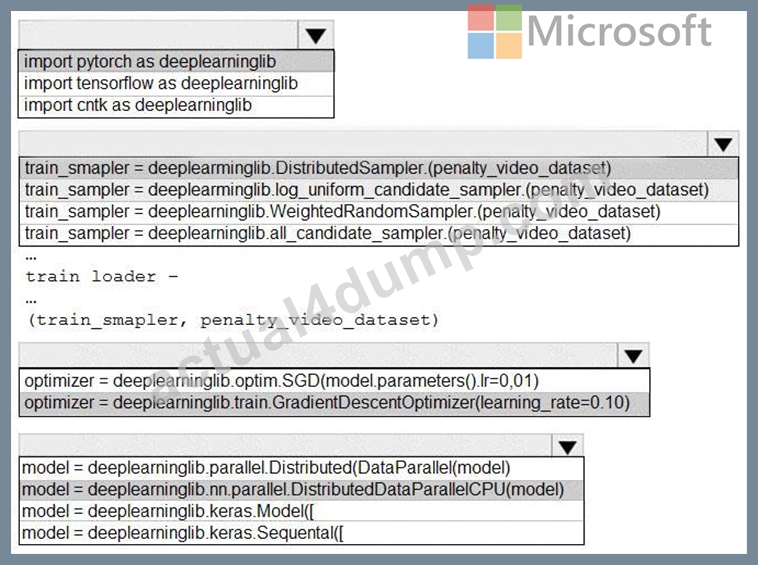
Box 1: import pytorch as deeplearninglib
Box 2: ..DistributedSampler(Sampler)..
DistributedSampler(Sampler):
Sampler that restricts data loading to a subset of the dataset.
It is especially useful in conjunction with class:`torch.nn.parallel.DistributedDataParallel`. In such case, each process can pass a DistributedSampler instance as a DataLoader sampler, and load a subset of the original dataset that is exclusive to it.
Scenario: Sampling must guarantee mutual and collective exclusively between local and global segmentation models that share the same features.
Box 3: optimizer = deeplearninglib.train. GradientDescentOptimizer(learning_rate=0.10)
NEW QUESTION 136
You are evaluating a completed binary classification machine learning model.
You need to use the precision as the valuation metric.
Which visualization should you use?
- A. Binary classification confusion matrix
- B. Violin pilot
- C. Box pilot
- D. Gradient descent
Answer: A
Explanation:
Explanation/Reference:
References:
https://machinelearningknowledge.ai/confusion-matrix-and-performance-metrics-machine-learning/
NEW QUESTION 137
You are creating a machine learning model. You have a dataset that contains null rows.
You need to use the Clean Missing Data module in Azure Machine Learning Studio to identify and resolve the null and missing data in the dataset.
Which parameter should you use?
- A. Hot Deck
- B. Remove entire column
- C. Replace with mode
- D. Custom substitution value
- E. Replace with mean
- F. Remove entire row
Answer: F
Explanation:
Remove entire row: Completely removes any row in the dataset that has one or more missing values. This is useful if the missing value can be considered randomly missing.
References:
https://docs.microsoft.com/en-us/azure/machine-learning/studio-module-reference/clean-missing-data
NEW QUESTION 138
You have a Python data frame named salesData in the following format:
The data frame must be unpivoted to a long data format as follows:
You need to use the pandas.melt() function in Python to perform the transformation.
How should you complete the code segment? To answer, select the appropriate options in the answer area.
NOTE: Each correct selection is worth one point.
Answer:
Explanation:
References:
https://pandas.pydata.org/pandas-docs/stable/reference/api/pandas.melt.html
NEW QUESTION 139
You create a binary classification model to predict whether a person has a disease.
You need to detect possible classification errors.
Which error type should you choose for each description? To answer, select the appropriate options in the answer area.
NOTE: Each correct selection is worth one point.

Answer:
Explanation:
Explanation:
Box 1: True Positive
A true positive is an outcome where the model correctly predicts the positive class Box 2: True Negative A true negative is an outcome where the model correctly predicts the negative class.
Box 3: False Positive
A false positive is an outcome where the model incorrectly predicts the positive class.
Box 4: False Negative
A false negative is an outcome where the model incorrectly predicts the negative class.
Note: Let's make the following definitions:
"Wolf" is a positive class.
"No wolf" is a negative class.
We can summarize our "wolf-prediction" model using a 2x2 confusion matrix that depicts all four possible outcomes:
Reference:
https://developers.google.com/machine-learning/crash-course/classification/true-false-positive-negative
NEW QUESTION 140
You are performing a classification task in Azure Machine Learning Studio.
You must prepare balanced testing and training samples based on a provided data set.
You need to split the data with a 0.75:0.25 ratio.
Which value should you use for each parameter? To answer, select the appropriate options in the answer area.
NOTE: Each correct selection is worth one point.
Answer:
Explanation:
Explanation
Box 1: Split rows
Use the Split Rows option if you just want to divide the data into two parts. You can specify the percentage of data to put in each split, but by default, the data is divided 50-50.
You can also randomize the selection of rows in each group, and use stratified sampling. In stratified sampling, you must select a single column of data for which you want values to be apportioned equally among the two result datasets.
Box 2: 0.75
If you specify a number as a percentage, or if you use a string that contains the "%" character, the value is interpreted as a percentage. All percentage values must be within the range (0, 100), not including the values 0 and 100.
Box 3: Yes
To ensure splits are balanced.
Box 4: No
If you use the option for a stratified split, the output datasets can be further divided by subgroups, by selecting a strata column.
Reference:
https://docs.microsoft.com/en-us/azure/machine-learning/studio-module-reference/split-data
NEW QUESTION 141
You use Azure Machine Learning Studio to build a machine learning experiment.
You need to divide data into two distinct datasets.
Which module should you use?
- A. Load Trained Model
- B. Assign Data to Clusters
- C. Group Data into Bins
- D. Split Data
Answer: C
Explanation:
Explanation
The Group Data into Bins module supports multiple options for binning data. You can customize how the bin edges are set and how values are apportioned into the bins.
References:
https://docs.microsoft.com/en-us/azure/machine-learning/studio-module-reference/group-data-into-bins
NEW QUESTION 142
You plan to use a Deep Learning Virtual Machine (DLVM) to train deep learning models using Compute Unified Device Architecture (CUDA) computations.
You need to configure the DLVM to support CUDA.
What should you implement?
- A. Computer Processing Unit (CPU) speed increase by using overcloking
- B. Graphic Processing Unit (GPU)
- C. Solid State Drives (SSD)
- D. Intel Software Guard Extensions (Intel SGX) technology
- E. High Random Access Memory (RAM) configuration
Answer: B
Explanation:
A Deep Learning Virtual Machine is a pre-configured environment for deep learning using GPU instances.
References:
https://azuremarketplace.microsoft.com/en-au/marketplace/apps/microsoft-ads.dsvm-deep-learning
NEW QUESTION 143
Note: This question is part of a series of questions that present the same scenario. Each question in the series contains a unique solution that might meet the stated goals. Some question sets might have more than one correct solution, while others might not have a correct solution.
After you answer a question in this section, you will NOT be able to return to it. As a result, these questions will not appear in the review screen.
You are using Azure Machine Learning to run an experiment that trains a classification model.
You want to use Hyperdrive to find parameters that optimize the AUC metric for the model. You configure a HyperDriveConfig for the experiment by running the following code:
You plan to use this configuration to run a script that trains a random forest model and then tests it with validation data. The label values for the validation data are stored in a variable named y_test variable, and the predicted probabilities from the model are stored in a variable named y_predicted.
Solution: Run the following code:
Does the solution meet the goal?
- A. No
- B. Yes
Answer: B
NEW QUESTION 144
You are developing a linear regression model in Azure Machine Learning Studio. You run an experiment to compare different algorithms.
The following image displays the results dataset output:
Use the drop-down menus to select the answer choice that answers each question based on the information presented in the image.
NOTE: Each correct selection is worth one point.
Answer:
Explanation:
Explanation
Box 1: Boosted Decision Tree Regression
Mean absolute error (MAE) measures how close the predictions are to the actual outcomes; thus, a lower score is better.
Box 2:
Online Gradient Descent: If you want the algorithm to find the best parameters for you, set Create trainer mode option to Parameter Range. You can then specify multiple values for the algorithm to try.
References:
https://docs.microsoft.com/en-us/azure/machine-learning/studio-module-reference/evaluate-model
https://docs.microsoft.com/en-us/azure/machine-learning/studio-module-reference/linear-regression
NEW QUESTION 145
You are creating a machine learning model in Python. The provided dataset contains several numerical columns and one text column.
*Biker
*Cars
*Vans
*Boats
You are building a regression model using the scikit- learn Python package.
You need to transform the text data to be compatible with the scikit-learn Python package How should you complete the code segment? To answer, select the appropriate options in the answer area.
NOTE: Each correct selection is worth one point.
Answer:
Explanation:
NEW QUESTION 146
You configure a Deep Learning Virtual Machine for Windows.
You need to recommend tools and frameworks to perform the following:
Build deep rwur.il network (DNN) models.
Perform interactive data exploration and visualization.
Which tools and frameworks should you recommend? To answer, drag the appropriate tools to the correct tasks. Each tool may be used once, more than once, or not at all. You may need to drag the split bar between panes or scroll to view content.
NOTE: Each correct selection is worth one point.
Answer:
Explanation:
NEW QUESTION 147
Note: This question is part of a series of questions that present the same scenario. Each question in the series contains a unique solution that might meet the stated goals. Some question sets might have more than one correct solution, while others might not have a correct solution.
After you answer a question in this section, you will NOT be able to return to it. As a result, these questions will not appear in the review screen.
You are analyzing a numerical dataset which contains missing values in several columns.
You must clean the missing values using an appropriate operation without affecting the dimensionality of the feature set.
You need to analyze a full dataset to include all values.
Solution: Use the Last Observation Carried Forward (LOCF) method to impute the missing data points.
Does the solution meet the goal?
- A. Yes
- B. No
Answer: B
Explanation:
Instead use the Multiple Imputation by Chained Equations (MICE) method.
Replace using MICE: For each missing value, this option assigns a new value, which is calculated by using a method described in the statistical literature as "Multivariate Imputation using Chained Equations" or "Multiple Imputation by Chained Equations". With a multiple imputation method, each variable with missing data is modeled conditionally using the other variables in the data before filling in the missing values.
Note: Last observation carried forward (LOCF) is a method of imputing missing data in longitudinal studies. If a person drops out of a study before it ends, then his or her last observed score on the dependent variable is used for all subsequent (i.e., missing) observation points. LOCF is used to maintain the sample size and to reduce the bias caused by the attrition of participants in a study.
References:
https://methods.sagepub.com/reference/encyc-of-research-design/n211.xml
https://www.ncbi.nlm.nih.gov/pmc/articles/PMC3074241/
NEW QUESTION 148
You need to implement early stopping criteria as suited in the model training requirements.
Which three code segments should you use to develop the solution? To answer, move the appropriate code segments from the list of code segments to the answer area and arrange them in the correct order.
NOTE: More than one order of answer choices is correct. You will receive credit for any of the correct orders you select.
Answer:
Explanation:
Explanation
You need to implement an early stopping criterion on models that provides savings without terminating promising jobs.
Truncation selection cancels a given percentage of lowest performing runs at each evaluation interval. Runs are compared based on their performance on the primary metric and the lowest X% are terminated.
Example:
from azureml.train.hyperdrive import TruncationSelectionPolicy
early_termination_policy = TruncationSelectionPolicy(evaluation_interval=1, truncation_percentage=20, delay_evaluation=5)
NEW QUESTION 149
You are analyzing the asymmetry in a statistical distribution.
The following image contains two density curves that show the probability distribution of two datasets.
Use the drop-down menus to select the answer choice that answers each question based on the information presented in the graphic.
NOTE: Each correct selection is worth one point.
Answer:
Explanation:
Explanation
Explanation:
Box 1: Positive skew
Positive skew values means the distribution is skewed to the right.
Box 2: Negative skew
Negative skewness values mean the distribution is skewed to the left.
References:
https://docs.microsoft.com/en-us/azure/machine-learning/studio-module-reference/compute-elementary-statistics
NEW QUESTION 150
You use the Azure Machine Learning Python SDK to define a pipeline that consists of multiple steps.
When you run the pipeline, you observe that some steps do not run. The cached output from a previous run is used instead.
You need to ensure that every step in the pipeline is run, even if the parameters and contents of the source directory have not changed since the previous run.
What are two possible ways to achieve this goal? Each correct answer presents a complete solution.
NOTE: Each correct selection is worth one point.
- A. Set the allow_reuse property of each step in the pipeline to False.
- B. Set the outputs property of each step in the pipeline to True.
- C. Set the regenerate_outputs property of the pipeline to True.
- D. Restart the compute cluster where the pipeline experiment is configured to run.
- E. Use a PipelineData object that references a datastore other than the default datastore.
Answer: A,C
Explanation:
B: If regenerate_outputs is set to True, a new submit will always force generation of all step outputs, and disallow data reuse for any step of this run. Once this run is complete, however, subsequent runs may reuse the results of this run.
C: Keep the following in mind when working with pipeline steps, input/output data, and step reuse.
* If data used in a step is in a datastore and allow_reuse is True, then changes to the data change won't be detected. If the data is uploaded as part of the snapshot (under the step's source_directory), though this is not recommended, then the hash will change and will trigger a rerun.
Reference:
https://docs.microsoft.com/en-us/python/api/azureml-pipeline-core/azureml.pipeline.core.pipelinestep
https://github.com/Azure/MachineLearningNotebooks/blob/master/how-to-use-azureml/machine-learning- pipelines/intro-to-pipelines/aml-pipelines-getting-started.ipynb Prepare data for modeling Testlet 1 Case study Overview You are a data scientist in a company that provides data science for professional sporting events. Models will use global and local market data to meet the following business goals:
* Understand sentiment of mobile device users at sporting events based on audio from crowd reactions.
* Assess a user's tendency to respond to an advertisement.
* Customize styles of ads served on mobile devices.
* Use video to detect penalty events
Current environment
* Media used for penalty event detection will be provided by consumer devices. Media may include images and videos captured during the sporting event and shared using social media. The images and videos will have varying sizes and formats.
* The data available for model building comprises of seven years of sporting event media. The sporting event media includes; recorded video transcripts or radio commentary, and logs from related social media feeds captured during the sporting events.
* Crowd sentiment will include audio recordings submitted by event attendees in both mono and stereo formats.
Penalty detection and sentiment
* Data scientists must build an intelligent solution by using multiple machine learning models for penalty event detection.
* Data scientists must build notebooks in a local environment using automatic feature engineering and model building in machine learning pipelines.
* Notebooks must be deployed to retrain by using Spark instances with dynamic worker allocation.
* Notebooks must execute with the same code on new Spark instances to recode only the source of the data.
* Global penalty detection models must be trained by using dynamic runtime graph computation during training.
* Local penalty detection models must be written by using BrainScript.
* Experiments for local crowd sentiment models must combine local penalty detection data.
* Crowd sentiment models must identify known sounds such as cheers and known catch phrases. Individual crowd sentiment models will detect similar sounds.
* All shared features for local models are continuous variables.
* Shared features must use double precision. Subsequent layers must have aggregate running mean and standard deviation metrics available.
Advertisements
During the initial weeks in production, the following was observed:
* Ad response rated declined.
* Drops were not consistent across ad styles.
* The distribution of features across training and production data are not consistent Analysis shows that, of the 100 numeric features on user location and behavior, the 47 features that come from location sources are being used as raw features. A suggested experiment to remedy the bias and variance issue is to engineer 10 linearly uncorrelated features.
* Initial data discovery shows a wide range of densities of target states in training data used for crowd sentiment models.
* All penalty detection models show inference phases using a Stochastic Gradient Descent (SGD) are running too slow.
* Audio samples show that the length of a catch phrase varies between 25%-47% depending on region
* The performance of the global penalty detection models shows lower variance but higher bias when comparing training and validation sets. Before implementing any feature changes, you must confirm the bias and variance using all training and validation cases.
* Ad response models must be trained at the beginning of each event and applied during the sporting event.
* Market segmentation models must optimize for similar ad response history.
* Sampling must guarantee mutual and collective exclusively between local and global segmentation models that share the same features.
* Local market segmentation models will be applied before determining a user's propensity to respond to an advertisement.
* Ad response models must support non-linear boundaries of features.
* The ad propensity model uses a cut threshold is 0.45 and retrains occur if weighted Kappa deviated from
0.1 +/- 5%.
* The ad propensity model uses cost factors shown in the following diagram: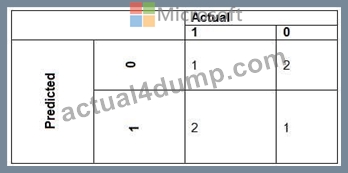
* The ad propensity model uses proposed cost factors shown in the following diagram:
* Performance curves of current and proposed cost factor scenarios are shown in the following diagram:
NEW QUESTION 151
Note: This question is part of a series of questions that present the same scenario. Each question in the series contains a unique solution that might meet the stated goals. Some question sets might have more than one correct solution, while others might not have a correct solution.
After you answer a question in this section, you will NOT be able to return to it. As a result, these questions will not appear in the review screen.
You train and register a machine learning model.
You plan to deploy the model as a real-time web service. Applications must use key-based authentication to use the model.
You need to deploy the web service.
Solution:
Create an AciWebservice instance.
Set the value of the ssl_enabled property to True.
Deploy the model to the service.
Does the solution meet the goal?
- A. Yes
- B. No
Answer: B
Explanation:
Instead use only auth_enabled = TRUE
Note: Key-based authentication.
Web services deployed on AKS have key-based auth enabled by default. ACI-deployed services have key-based auth disabled by default, but you can enable it by setting auth_enabled = TRUE when creating the ACI web service. The following is an example of creating an ACI deployment configuration with key-based auth enabled.
deployment_config <- aci_webservice_deployment_config(cpu_cores = 1,
memory_gb = 1,
auth_enabled = TRUE)
Reference:
https://azure.github.io/azureml-sdk-for-r/articles/deploying-models.html
NEW QUESTION 152
......
Download Exam DP-100 Practice Test Questions with 100% Verified Answers: https://examsforall.actual4dump.com/Microsoft/DP-100-actualtests-dumps.html