

Linux Foundation CKA Exam Dumps [2023] Practice Valid Exam Dumps Question
CKA Dumps - Grab Out For [NEW-2023] Linux Foundation Exam
The Linux Foundation CKA (Certified Kubernetes Administrator) Program Exam is a certification exam designed to test the skills and knowledge of system administrators and developers who work with Kubernetes. Kubernetes is an open-source container orchestration tool that is rapidly gaining popularity in the IT industry. With the increasing demand for skilled professionals who can deploy and manage Kubernetes clusters, the CKA exam has become a popular certification for those looking to advance their careers in this field.
NEW QUESTION # 13
Get the DNS records for the service and pods for the deployment redis and the put the value in /tmp/dnsrecordpod and /tmp/dnsrecord-service
- A. // Get Pod Ip
kubectl get po -o wide
// Get Service Name
kubectl get svc
// Create a temporary pod and execute nslookup command
Note: POD IP format should be a-b-c-d and not a.b.c.d
kubectl run busybox --image=busybox:1.28 --restart=Never -
-rm -it -- nslookup 192-168-0-69.default.pod >
/tmp/dnsrecord-pod
kubectl run busybox1 --image=busybox:1.26 --restart=Never
--rm -it -- nslookup redis-service > /tmp/dnsrecordservice
//Verify
cat /tmp/dnsrecord-pod
Server: 10.2.8.10
Address 1: 10.2.0.10 kube-dns.kube system.svc.cluster.local Name: 192-168-0-69.default.pod Address 1: 192.168.0.69 192-166-0-69.redis service.default.svc.cluster.local cat /tmp/dnsrecord-pod Server: 10.2.0.10 Address 1: 10.2.0.10 kube-dns.kube system.svc.cluster.local Name: 192-168-0-69.default.pod Address 1: 192.168.0.69 192-168-0-69.redis service.default.svc.cluster.local - B. // Get Pod Ip
kubectl get po -o wide
// Get Service Name
kubectl get svc
// Create a temporary pod and execute nslookup command
Note: POD IP format should be a-b-c-d and not a.b.c.d
kubectl run busybox --image=busybox:1.28 --restart=Never -
-rm -it -- nslookup 192-168-0-69.default.pod >
/tmp/dnsrecord-pod
kubectl run busybox1 --image=busybox:1.28 --restart=Never
--rm -it -- nslookup redis-service > /tmp/dnsrecordservice
//Verify
cat /tmp/dnsrecord-pod
Server: 10.2.0.10
Address 1: 10.2.0.10 kube-dns.kube system.svc.cluster.local Name: 192-168-0-69.default.pod Address 1: 192.168.0.69 192-168-0-69.redis service.default.svc.cluster.local cat /tmp/dnsrecord-pod Server: 10.2.0.10 Address 1: 10.2.0.10 kube-dns.kube system.svc.cluster.local Name: 192-168-0-69.default.pod Address 1: 192.168.0.69 192-168-0-69.redis service.default.svc.cluster.local
Answer: B
NEW QUESTION # 14
Create a namespace called 'development' and a pod with image nginx called nginx on this namespace.
Answer:
Explanation:
kubectl create namespace development kubectl run nginx --image=nginx --restart=Never -n development
NEW QUESTION # 15
Create an nginx pod and list the pod with different levels of verbosity
- A. // create a pod
kubectl run nginx --image=nginx --restart=Never --port=80
// List the pod with different verbosity
kubectl get po nginx --v=7
kubectl get po nginx --v=8
kubectl get po nginx --v=9 - B. // create a pod
kubectl run nginx --image=nginx --restart=Never --port=80
// List the pod with different verbosity
kubectl get po nginx --v=7
kubectl get po nginx --v=6
kubectl get po nginx --v=9
Answer: A
NEW QUESTION # 16
Configure the kubelet systemd- managed service, on the node labelled with name=wk8s-node-1, to launch a pod containing a single container of Image httpd named webtool automatically. Any spec files required should be placed in the /etc/kubernetes/manifests directory on the node.
You can ssh to the appropriate node using:
[student@node-1] $ ssh wk8s-node-1
You can assume elevated privileges on the node with the following command:
[student@wk8s-node-1] $ | sudo -i
Answer:
Explanation:
See the solution below.
Explanation
solution
F:\Work\Data Entry Work\Data Entry\20200827\CKA\21 C.JPG
F:\Work\Data Entry Work\Data Entry\20200827\CKA\21 D.JPG
F:\Work\Data Entry Work\Data Entry\20200827\CKA\21 E.JPG
F:\Work\Data Entry Work\Data Entry\20200827\CKA\21 F.JPG
F:\Work\Data Entry Work\Data Entry\20200827\CKA\21 G.JPG
NEW QUESTION # 17
Create a Cronjob with busybox image that prints date and hello from kubernetes cluster message for every minute
- A. CronJob Syntax:
* --> Minute
* --> Hours
* --> Day of The Month
* --> Month
* --> Day of the Week
*/1 * * * * --> Execute a command every one minutes.
vim date-job.yaml
apiVersion: batch/v1beta1
kind: CronJob
metadata:
name: date-job
spec:
schedule: "*/1 * * * *"
jobTemplate:
spec:
template:
spec:
containers:
- name: hello
image: busybox
args:
- /bin/sh
- -c
- date; echo Hello from the Kubernetes cluster
restartPolicy: OnFailure
kubectl apply -f date-job.yaml
//Verify
kubectl get cj date-job -o yaml - B. CronJob Syntax:
* --> Minute
* --> Hours
* --> Day of The Month
* --> Month
* --> Day of the Week
*/1 * * * * --> Execute a command every one minutes.
vim date-job.yaml
apiVersion: batch/v1beta1
kind: CronJob
metadata:
name: date-job
spec:
schedule: "*/1 * * * *"
jobTemplate:
spec:
template:
- /bin/sh
- -c
- date; echo Hello from the Kubernetes cluster
restartPolicy: OnFailure
kubectl apply -f date-job.yaml
//Verify
kubectl get cj date-job -o yaml
Answer: A
NEW QUESTION # 18
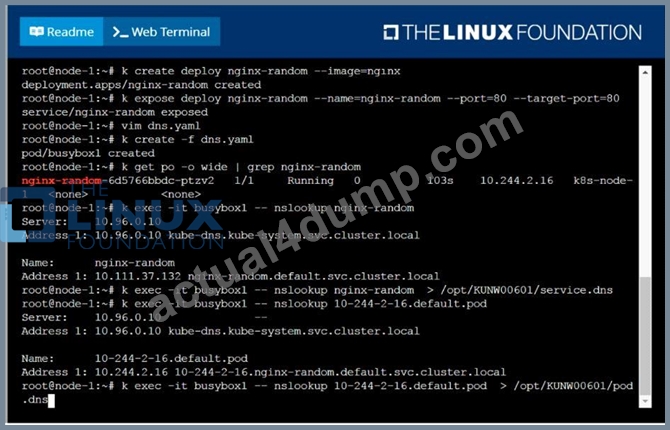
Create a deployment as follows:
Name: nginx-random
Exposed via a service nginx-random
Ensure that the service & pod are accessible via their respective DNS records The container(s) within any pod(s) running as a part of this deployment should use the nginx Image Next, use the utility nslookup to look up the DNS records of the service & pod and write the output to /opt/KUNW00601/service.dns and /opt/KUNW00601/pod.dns respectively.
Answer:
Explanation:
Solution:

NEW QUESTION # 19
Get list of PVs and order by size and write to file "/opt/pvstorage.txt"
Answer:
Explanation:
kubectl get pv --sort-by=.spec.capacity.storage > /opt/pv storage.txt
NEW QUESTION # 20
Get list of all the pods showing name and namespace with a jsonpath expression.
Answer:
Explanation:
kubectl get pods -o=jsonpath="{.items[*]['metadata.name'
, 'metadata.namespace']}"
NEW QUESTION # 21
Create a deployment called webapp with image nginx having 5 replicas in it, put the file in /tmp directory with named webapp.yaml
- A. //Create a file using dry run command
kubectl create deploy --image=nginx --dry-run -o yaml >
/tmp/webapp.yaml
// Now, edit file webapp.yaml and update replicas=5
apiVersion: apps/v1
kind: Deployment
metadata:
labels:
app: webapp
name: webapp
spec:
replicas: 5
selector:
matchLabels:
app: webapp
template:
metadata:
labels:
Note: Search "deployment" in kubernetes.io site , you will get
the page
https://kubernetes.io/docs/concepts/workloads/controllers/deplo
yment/
// Verify the Deployment
kubectl get deploy webapp --show-labels
// Output the YAML file of the deployment webapp
kubectl get deploy webapp -o yaml - B. //Create a file using dry run command
kubectl create deploy --image=nginx --dry-run -o yaml >
/tmp/webapp.yaml
// Now, edit file webapp.yaml and update replicas=5
apiVersion: apps/v1
kind: Deployment
metadata:
labels:
app: webapp
name: webapp
spec:
replicas: 5
selector:
matchLabels:
app: webapp
template:
metadata:
labels:
app: webapp
spec:
containers:
- image: nginx
name: nginx
Note: Search "deployment" in kubernetes.io site , you will get
the page
https://kubernetes.io/docs/concepts/workloads/controllers/deplo
yment/
// Verify the Deployment
kubectl get deploy webapp --show-labels
// Output the YAML file of the deployment webapp
kubectl get deploy webapp -o yaml
Answer: B
NEW QUESTION # 22
Task Weight: 4%
Task
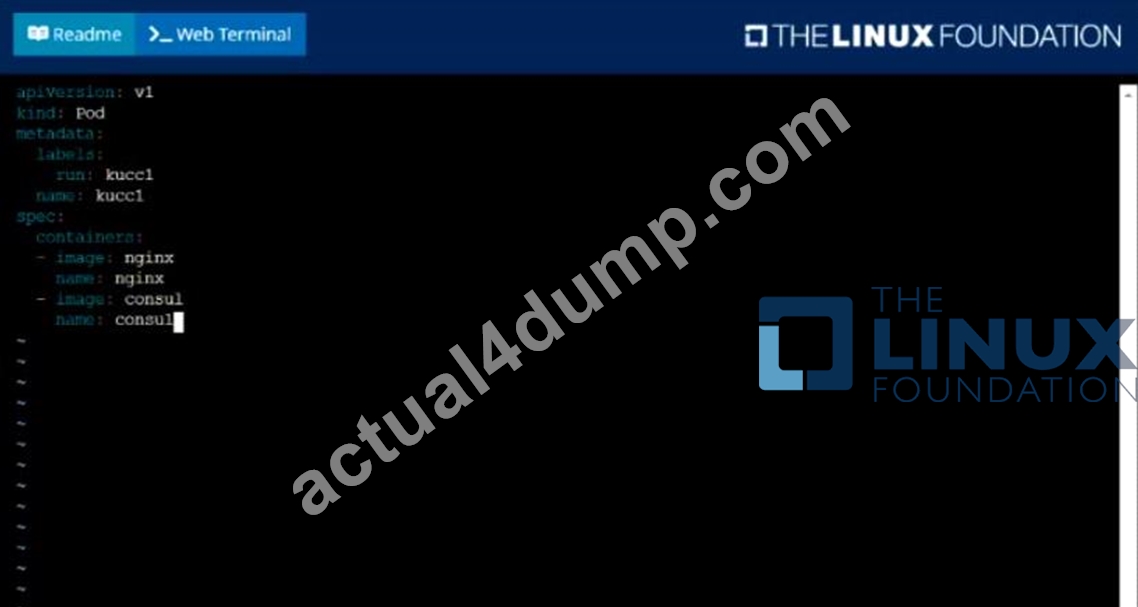
Schedule a Pod as follows:
* Name: kucc1
* App Containers: 2
* Container Name/Images:
o nginx
o consul
Answer:
Explanation:
Solution:

NEW QUESTION # 23
Create a NetworkPolicy which denies all ingress traffic
- A. apiVersion: networking.k8s.io/v1
kind: NetworkPolicy
metadata:
name: default-deny
spec:
podSelector: ()
policyTypes:
- Ingress - B. apiVersion: networking.k8s.io/v1
kind: NetworkPolicy
metadata:
name: default-deny
spec:
podSelector: {}
policyTypes:
- Ingress
Answer: B
NEW QUESTION # 24
Score: 7%
Task
Create a new NetworkPolicy named allow-port-from-namespace in the existing namespace echo. Ensure that the new NetworkPolicy allows Pods in namespace my-app to connect to port 9000 of Pods in namespace echo.
Further ensure that the new NetworkPolicy:
* does not allow access to Pods, which don't listen on port 9000
* does not allow access from Pods, which are not in namespace my-app
Answer:
Explanation:
See the solution below.
Explanation
Solution:
#network.yaml
apiVersion: networking.k8s.io/v1
kind: NetworkPolicy
metadata:
name: allow-port-from-namespace
namespace: internal
spec:
podSelector:
matchLabels: {
}
policyTypes:
- Ingress
ingress:
- from:
- podSelector: {
}
ports:
- protocol: TCP
port: 8080
#spec.podSelector namespace pod
kubectl create -f network.yaml
NEW QUESTION # 25
Create a job named "hello-job" with the image busybox which echos "Hello I'm running job"
- A. kubectl create job hello-job --image=busybox --dry-run -o yaml
-- echo "Hello I'm running job" > hello-job.yaml
kubectl create -f hello-job.yaml
//Verify Job
kubectl get job
kubectl get po
kubectl logs hello-job-* - B. kubectl create job hello-job --image=busybox --dry-run -o yaml
-- echo "Hello I'm running job" > hello-job.yaml
kubectl create -f hello-job.yaml
//Verify Job
kubectl get po
kubectl logs hello-job-*
Answer: A
NEW QUESTION # 26
Score: 7%
Task
Create a new nginx Ingress resource as follows:
* Name: ping
* Namespace: ing-internal
* Exposing service hi on path /hi using service port 5678
Answer:
Explanation:
Solution:
vi ingress.yaml
#
apiVersion: networking.k8s.io/v1
kind: Ingress
metadata:
name: ping
namespace: ing-internal
spec:
rules:
- http:
paths:
- path: /hi
pathType: Prefix
backend:
service:
name: hi
port:
number: 5678
#
kubectl create -f ingress.yaml
NEW QUESTION # 27
Create a deployment as follows:
* Name: nginx-app
* Using container nginx with version 1.11.10-alpine
* The deployment should contain 3 replicas
Next, deploy the application with new version 1.11.13-alpine, by performing a rolling update.
Finally, rollback that update to the previous version 1.11.10-alpine.
Answer:
Explanation:
See the solution below.
Explanation
solution


NEW QUESTION # 28
Create an nginx pod with container Port 80 and it should only receive traffic only it checks the endpoint / on port 80 and verify and delete the pod.
- A. kubectl run nginx --image=nginx --restart=Never --port=80 --
dry-run -o yaml > nginx-pod.yaml
// add the readinessProbe section and create
vim nginx-pod.yaml
run: nginx
name: nginx
spec:
containers:
- image: nginx
name: nginx
ports:
- containerPort: 60
readinessProbe:
httpGet:
path: /
port: 60
restartPolicy: Never
kubectl apply -f nginx-pod.yaml
// verify
kubectl describe pod nginx | grep -i readiness
kubectl delete po nginx - B. kubectl run nginx --image=nginx --restart=Never --port=80 --
dry-run -o yaml > nginx-pod.yaml
// add the readinessProbe section and create
vim nginx-pod.yaml
apiVersion: v1
kind: Pod
metadata:
labels:
run: nginx
name: nginx
spec:
containers:
- image: nginx
name: nginx
ports:
- containerPort: 80
readinessProbe:
httpGet:
path: /
port: 80
restartPolicy: Never
kubectl apply -f nginx-pod.yaml
// verify
kubectl describe pod nginx | grep -i readiness
kubectl delete po nginx
Answer: B
NEW QUESTION # 29
Create a configmap called myconfigmap with literal value
appname=myapp
- A. kubectl create cm myconfigmap --from-literal=appname=myapp
// Verify
kubectl get cm -o yaml
(or)
kubectl describe cm - B. kubectl create cm myconfigmap --from-literal=appname=myapp
// Verify
(or)
kubectl describe cm
Answer: A
NEW QUESTION # 30
Create a pod with image nginx called nginx and allow traffic on port 80
Answer:
Explanation:
See the solution below.
Explanation
kubectlrun nginx --image=nginx --restart=Never --port=80
NEW QUESTION # 31
......
The CKA program is designed for professionals who want to demonstrate their expertise in Kubernetes administration. The certification is suitable for IT professionals, cloud architects, DevOps engineers, and system administrators who work with Kubernetes. The CKA program provides a rigorous testing process that ensures that certified professionals have the skills and knowledge to work with Kubernetes in real-world scenarios.
CKA Exam Dumps PDF Guaranteed Success with Accurate & Updated Questions: https://examsforall.actual4dump.com/Linux-Foundation/CKA-actualtests-dumps.html